

Coming soon · Quad AG
The Microbiome Management Guide
Plant and Soil Edition
Understanding the living relationships behind plant growth, and the role of humic and fulvic substances.

Microbiome Management in soil & plants
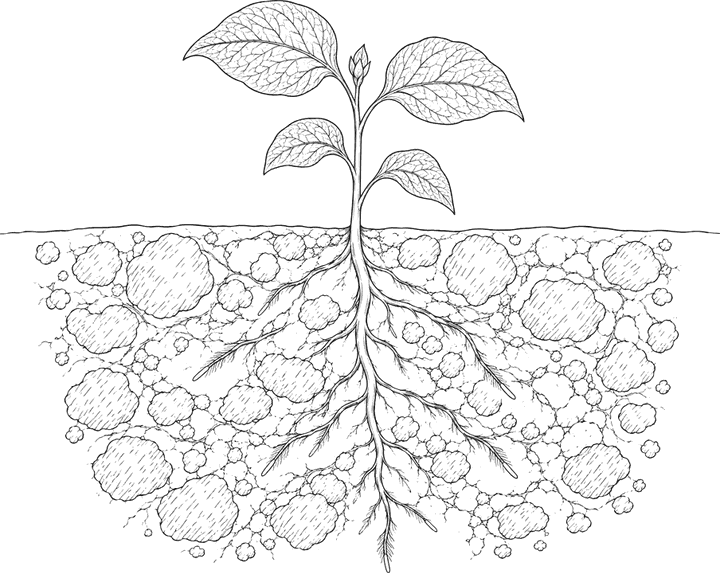
A field or a greenhouse, a row of young plants, and under each one a root system working through the soil. Living roots release carbon that feeds the microbes around them, and water connects every scale, from rain on the field to the thin layer of water around a mineral grain.
Seen and unseen
A plant, the living soil around its roots, and a millimetre of the rhizosphere: the root, the carbon it releases, bacteria, fungal hyphae and a soil crumb. A teaspoon of productive soil generally holds 100 million to 1 billion bacteria.2
Resources, physical conditions and management.
Functions and interactions within the community.
What can be measured in the host or wider system.
The root zone
Observable function Root mass and leaf tissue analysis
Why this system is investigated. A living root changes the chemistry of the soil around it, and humic and fulvic substances are reactive in that same water: they carry charge, hold nutrient ions and bind metals. The questions here run from the root environment to the material’s chemistry, to the plant’s response, and to the microbes that live on what the root releases.
Across 81 studies, humic substances raised early plant growth on average, with wide variation, and field trials range from small gains to none, so the material, the soil and the measurement are read together.
Why the setting matters
Five scales, one system. Living roots and the water around them connect each scale to the next, which is why a question about a crop is also a question about the soil it grows in.
Where the roots grow sets everything that follows: the soil or substrate, how water arrives, how nutrients are supplied. A greenhouse is a setting, and its plants may grow in soil, in a substrate or in a nutrient solution.
Water. Rain or irrigation enters the root zone. Some is taken up by roots; some drains away with whatever is dissolved in it.
Leaves fix carbon from the air. Part of that recently fixed carbon travels to the roots, and part of what reaches the roots passes into the soil, released directly or through the fungi that partner with them.3
Water. Water moves up from root to leaf and leaves through the leaves, so the roots keep drawing more from the soil.
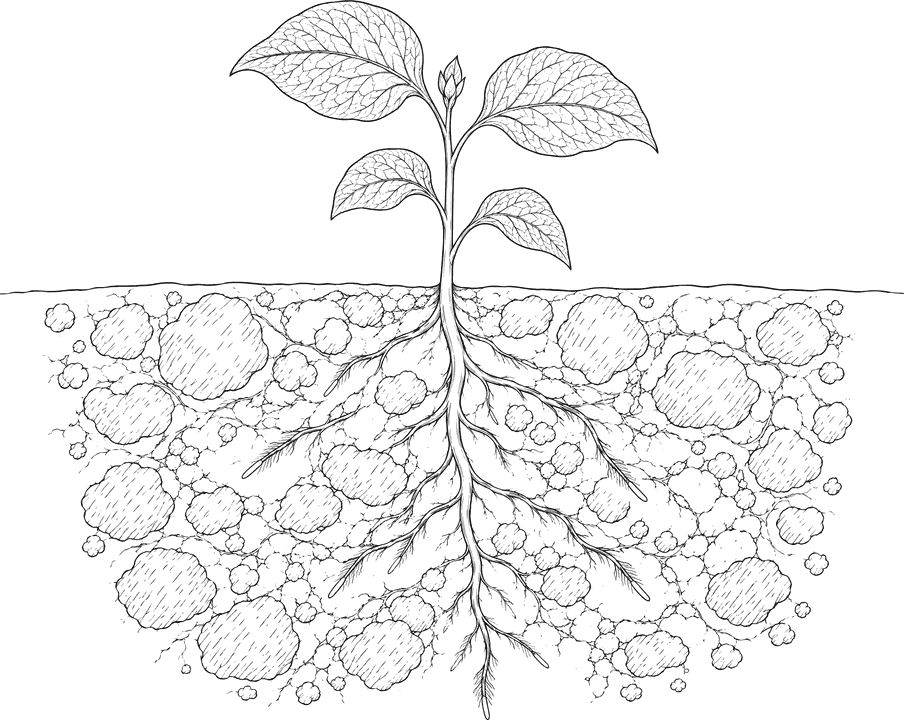
Roots branch through soil crumbs and the pores between them. Each living root changes the soil immediately around it.1
Water. Roots take up water and the nutrients dissolved in it.
At the smallest scale, organic matter meets a mineral grain. Soluble compounds, much of them already processed by microbes, attach to mineral surfaces in patches, and what attaches is protected from decomposers. How long carbon stays depends on these surroundings more than on its chemistry.4,5
Water. Dissolved compounds reach the mineral surface in water.
What is happening here
The rhizosphere is the region of soil influenced by a living root. Compounds released by roots help shape microbial activity nearby, connecting the plant with its surrounding soil community.1,2
It is one of four places a microbe can live in relation to a root, and the research below keeps them apart: a change in the soil community, on the root surface and inside the root are different findings.
The wider setting of particles, pores, organic material and organisms.
The soil region influenced by the living root.
The interface between the root and its surroundings.
Plant tissue, distinct from the soil and the root surface. Microbes that live inside plant tissue are called endophytes.
Define the growing system
Start by identifying where the roots are growing and how water, nutrients and environmental conditions are managed. Field soil, growing substrates and nutrient solutions require different descriptions and measurements.
Consider the soil profile, crop history, rooting conditions, water movement, fertility program and seasonal conditions.
Questions
Consider the growing medium, container or bed, irrigation pattern, drainage, nutrient program and crop stage.
Questions
Consider solution management, root-zone oxygen, nutrient supply, temperature, recirculation and system hygiene.
Questions
Protected growing can use soil, substrates or nutrient solutions. “Greenhouse” describes the growing setting, not a single root environment.
The framework in this setting
The framework sorts what to examine: the conditions, the biological activity, and what can be observed in the plant and the system. Applied to the Iowa maize study featured below, it shows which part of the explanation was measured and which was not.12
Eroded upland soil and a seasonally wet lowland in the same rainfed Iowa fields, over four site-years with dry and wet seasons.
Not measured in this study. The framework keeps it as the open part of the explanation, not an assumed cause.
Grain yield read along each strip by soil position: no field-wide effect, and gains of 7 to 19 percent on the upland soil.
A greener leaf, larger root system or higher yield is an observation. Establishing why it changed requires suitable measurements and comparisons.
What is established
Across 81 studies, humic substances raised shoot dry weight by an average of 22 percent and root dry weight by 21 percent, with wide spread: about half the shoot studies found less than a 5 percent gain. Compost-derived materials raised shoot growth; peat-derived materials did not; stressed plants responded more than unstressed ones. Most studies measured early growth, not field yield.8
In rice seedlings grown short of phosphate, a fulvic preparation raised phosphorus uptake by about 20 percent at three of four doses. The gain ran through the root: roots acidified the solution around them. When the researchers held the solution’s pH steady, the gain disappeared.10
The measurement is phosphorus taken up by the plant. It says nothing about the fulvic material itself entering the root.
A pH free to change: the solution beside the root acidifies, and phosphorus uptake rose by about 20 percent.
B pH held steady: no gain.
In laboratory maize seedlings, a humic acid from vermicompost lengthened roots, increased lateral root emergence and raised root proton pump activity.9
Tritium from a labelled leonardite humic acid entered wheat seedling roots within 24 hours. Most stayed in the roots; a small portion reached the shoots. The label may travel on breakdown products, so it does not show the intact material crossing into the plant.11
What is being investigated
Selected research
A controlled experiment can isolate a response; a field study shows whether it survives soil, weather and scale. In the field, results divide. A micronized leonardite product raised Iowa maize yield only on eroded upland soil; in replicated Iowa production fields a leonardite extract raised it by 1 to 4 percent. University trials in processing tomato, and 35 Ontario trials in dry bean, found no effect.12,13,14,15
De Hita and colleagues applied a sedimentary humic acid to cucumber roots in nutrient solution, or sprayed it on the leaves. Both routes improved shoot and root growth, but the short-term root responses differed: root application raised root proton pump activity and root abscisic acid; leaf application did not.
Limitation. A short-term hydroponic experiment in one species; the responses concern this preparation and these conditions.
Funding. Cátedra Timac Agro grant; one author is at the Roullier Group’s innovation centre.
Interpretation. Similar growth outcomes did not mean identical mechanisms. The findings apply to this preparation, this species and these hydroponic conditions, not to field soils.
Olk and colleagues sprayed a micronized leonardite product on rainfed maize in replicated, field-long strips on two Iowa farms over four site-years. No year showed a field-wide yield effect. On eroded upland soil, yields rose 7 to 19 percent, mostly in drier seasons; a wet lowland showed a small fall that was not significant.
Limitation. The link to weather rests on correlation and was not tested directly; significance was set at P < 0.10.
Funding. American Colloid Company and USDA-ARS; two authors were employed by Minerals Technologies.
Interpretation. A field result belongs to its soil, season, product and rate. The design could not identify a mechanism, and plant nutrient concentrations did not respond consistently.
In this collection. Four records for soil and plants: these two, a meta-analysis of 81 studies, and a tomato study run in greenhouse soil and in hydroponics.
What is being investigated
Whether a humic or fulvic material makes a growing system more sustainable is a comparison, not a label. The organic matter a soil builds for itself and an extracted commercial material are different things, and a product’s footprint runs from sourcing and extraction through transport and application. Each question names what would have to be measured.
Does less nitrogen or phosphorus leave the root zone?
Measure Nitrate and phosphorus in drainage, leachate or runoff, against an untreated comparison, through a season.
Does the crop produce more for the water it receives?
Measure Water applied or received, soil moisture and yield, from the same plots in the same season.
Does the soil end up holding more carbon than the material brought, after the cost of making and moving it?
Measure Soil organic carbon at fixed depths over several years, the carbon in the material applied, and the emissions from extracting and transporting it.
None of the four soil and plant records in this collection measured nutrient loss, water use or a carbon balance. Faster growth is not, on its own, lower emissions, and a carbon stock is context, not a removal result.
What to document when observing a growing system, so that a change can be read in context.
Choose observations that match the crop, growing system and decision. Record the conditions alongside the plant response so that a change can be interpreted in context.
| Area | Examples to document |
|---|---|
| Crop and stage | Species, cultivar, planting or transplant date, development stage. |
| Growing environment | Soil or substrate, rooting volume and relevant environmental conditions. |
| Water and nutrition | Irrigation, nutrient program and appropriate measurements at defined locations. |
| Root and plant development | Consistently collected observations of roots, canopy and growth. |
| Production | Relevant yield, quality or marketability measures at an appropriate stage. |
| Concurrent changes | Weather, management, pest pressure and other inputs or interventions. |
Use consistent methods and suitable comparisons. Photos can support a record, but visual differences alone do not establish a mechanism or treatment effect.
For recirculating or shared systems, the experimental unit may be the reservoir, bench or system rather than each individual plant. A formal evaluation should account for the actual arrangement.
Where to learn or contribute
Coming soon · Quad AG
Plant and Soil Edition
Understanding the living relationships behind plant growth, and the role of humic and fulvic substances.
Review a publication, interpret a record, or help design the measurements above: which parts of a humic or fulvic material soil microbes use as carbon, and whether a field loses less nitrogen, uses water better or holds more carbon.
Associated brand. Quad AG, run by the project’s founders, sells products for soil and plants. No study on this page tested its products.
How the project relates to its brandsPrepared by Carbon Biome Project, 19 October 2026; revised 22 October 2026. External scientific review of this page has not been completed. Citing the USDA Natural Resources Conservation Service does not imply its endorsement of the project.