Microbiome Management in dogs & cats

Dogs and cats share a home, not a digestive system.

Two bowls on the kitchen floor, filled at the same time each day. Once eaten, each meal travels through a different digestive system, with its own microbial community.

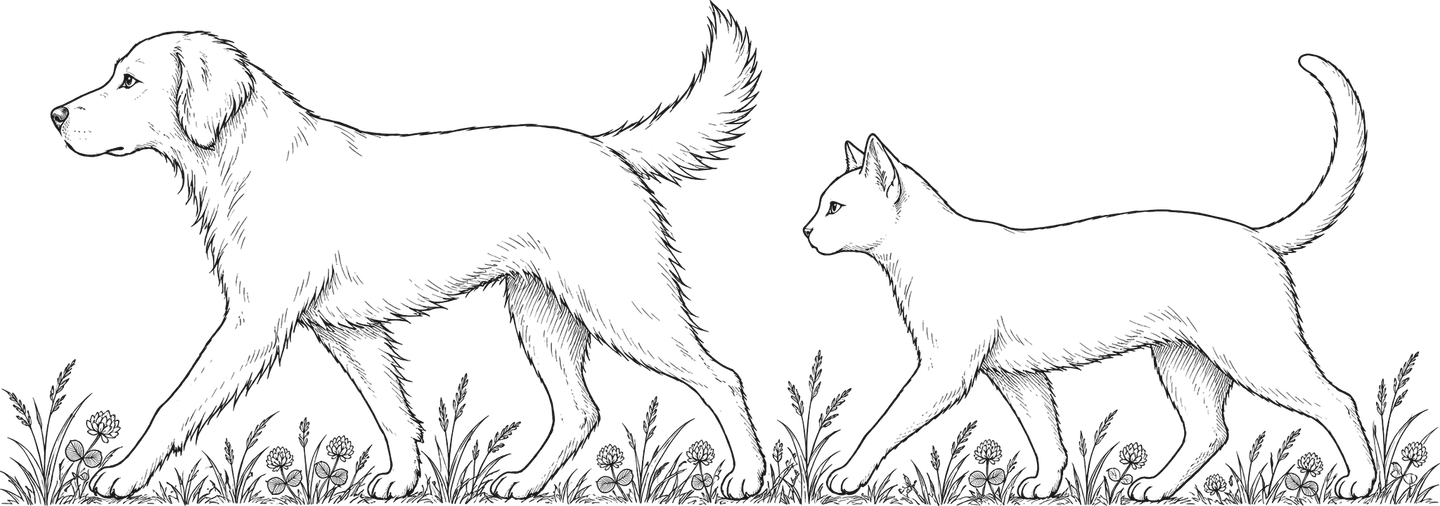
Illustration. Dog and cat drawn at the same body length, not to scale.

Why this setting matters

Feeding time, twice over.

A dog and a cat often share a kitchen, a routine and the person who fills both bowls. What each needs from its bowl is not the same.

The dog’s bowl

A facultative carnivore.

Dogs make plenty of the pancreatic enzyme that digests starch, and handle starchier food better than cats do.2

Worth noticing

  • What this dog actually eats, including treats and chews.
  • What changed before a digestive change.
The cat’s bowl

An obligate carnivore.

Cats need animal protein and fat in their food and do best on diets low in starch. A finding in dogs does not transfer to them automatically.2,3

Worth noticing

  • How much this cat actually eats, and whether another animal shares its food.
  • Changes to routine, household or feeding access.

In both animals, what is not digested earlier reaches the large intestine. There, microbes ferment undigested fibre and protein, and those microbes affect the stool an owner sees.2

What is happening inside

A dog and a cat, and the microbial world inside each.

A dog and a cat, and the microbial community in each one’s large intestine.2

Environmental conditions

Resources, physical conditions and management.

Microbial activity

Functions and interactions within the community.

Observable function

What can be measured in the host or wider system.

A dog and a cat walking in outline. Small boxes mark the rear of the abdomen of each, where the large intestine lies.
  1. Dog

    Magnified view of the large intestineThe colon wall along the top, lined with mucus whose inner part holds few microbes. Below, fragments of plant fibre and protein-rich residue from the diet, with bacteria attached along their surfaces and gathered at the torn ends of the fibre. A green tint marks the material that microbes attach to and break down.abcd
    • a Colon wall
    • b Food residue and fibre
    • c Bacteria
    • d Mucus layer

    Observable function Faecal score and body condition score

  2. Cat

    Magnified view of the cat's large intestineThe colon wall along the top, lined with mucus whose inner part holds few microbes. Below, mostly protein-rich food residue with only a little plant fibre, as in an obligate carnivore, with bacteria attached to the residue. A green tint marks the residue that microbes attach to and break down.abcd
    • a Colon wall
    • b Food residue
    • c Bacteria
    • d Mucus layer

    Observable function Faecal score and body condition score

  1. Faecal score and body condition score
  2. Faecal score and body condition score
Illustration. Magnified views are conceptual and not to scale.

Why this system is investigated. Dietary biology is the background: what a dog or a cat eats sets what reaches its large intestine and the microbes there. The research question is separate: what a humic or fulvic material does in a living dog or cat. The one humic record in this collection is a cell-culture study, pig intestinal cells and immune cells from one dog, and it did not study a living animal, which is where the question remains.

Two digestive environments

The same four regions, two different animals.

Dog and cat share the plan of the tract. What arrives in it, and what each animal can do with it, differs.1,2

Dog

Simplified canine digestive tractAn ordered schematic of the dog's digestive tract: 1, stomach; 2, small intestine; 3, large intestine, with a small caecum at its start; 4, rectum.12341234
A varied diet, including starch the dog can digest, sets what reaches the large intestine.

Cat

Simplified feline digestive tractAn ordered schematic of the cat's digestive tract: 1, stomach; 2, small intestine; 3, large intestine, with a small caecum at its start; 4, rectum.12341234
A diet built on animal protein and fat sets what reaches the large intestine.

Key, numbered the same in both diagrams

  1. 1

    Stomach

    An early compartment in food processing.

  2. 2

    Small intestine

    The main site of digestion and nutrient absorption.

  3. 3

    Large intestine

    Microbes ferment undigested fibre and protein, and water is absorbed.

  4. 4

    Rectum

    The final passage before elimination.

Simplified digestive anatomy. Diagrams are not to scale, and no size difference is drawn between the species.

A stool sample provides information about material leaving the tract. It does not directly describe every digestive compartment or explain every digestive sign.

The framework in companion animals

Follow function and adaptation over time.

Within the framework, Digestive Stability describes appropriate digestive function and the capacity to adapt through change.

For dogs and cats, the discussion begins with the individual animal’s usual pattern and the context of any departure from it.

  • Function

    What observations are usual for this animal, and which changes deserve attention?

  • Adaptation

    How do observations change through a feeding or routine transition?

  • Recovery

    Following disruption and any necessary care, how does function change over time?

Digestive Stability is a working concept, not a diagnosis or a single test result. Consistent-looking stool alone does not establish that every aspect of digestive health is normal.

  1. Digestive environment

  2. Microbial activity

  3. Animal-level observations

Observe, interpret and reassess.

What is established

Diet moves the gut community, species by species.

One feeding study in dogs and one in cats show how quickly, and how differently, gut microbes respond to a change of diet. They are context for reading any study in these animals. Neither tested a humic or fulvic material, and neither is an ingredient trial.

Dogs

  • Background biologyPublished study · Healthy adult dogs

    Researchers followed microbial and metabolite changes after a diet transition.

    A longitudinal study examined faecal microbial and metabolite measurements after an abrupt dietary change in healthy adult dogs. It reported shifts followed by stabilisation in the measurements studied.

    Limitation. Twelve laboratory Beagles followed for 13 days after each change; stability was described from five sampling days rather than tested formally.

    Funding. USDA and NomNomNow; three authors are employed by or hold stock options in NomNomNow.

    Interpretation. The study concerns the tested diets and healthy adult dogs. It does not establish a universal transition period, validate the project’s Digestive Stability concept or justify abrupt diet changes in routine care.

    Study design
    Crossover feeding trial with repeated sampling
    Material
    No humic or fulvic material tested; abrupt change from a dry experimental diet to the same diet with added soluble corn fibre, or to a commercial canned diet
    Source
    Lin et al., 2022. Longitudinal fecal microbiome and metabolite data demonstrate rapid shifts and subsequent stabilization after an abrupt dietary change in healthy adult dogs
    Read evidence summary

Cats

  • Background biologyPublished study · Adult cats

    Dietary responses differed with the cats’ starting characteristics.

    Li and Pan studied dietary protein-to-carbohydrate ratios in lean and overweight or obese adult cats. They reported differing faecal microbial responses, with more pronounced compositional changes in the overweight or obese group.

    Limitation. Thirty-nine colony cats with one faecal sample per phase, on diets designed by the funder's staff; microbial functions were predicted from 16S data, not measured.

    Funding. Nestlé Purina PetCare; both authors are Purina employees.

    Interpretation. The findings illustrate why population and dietary context matter. They do not establish a supplement effect, a weight-management recommendation or a universal ideal microbial profile.

    Study design
    Randomised controlled feeding trial, parallel groups within lean and overweight cats
    Material
    No humic or fulvic material tested; two dry diets designed by the funder, differing in protein to carbohydrate ratio
    Source
    Li and Pan, 2020. Differential Responses to Dietary Protein and Carbohydrate Ratio on Gut Microbiome in Obese vs. Lean Cats
    Read evidence summary

In this collection. Two background records on diet in dogs and cats, one laboratory cell study, and no study of a humic or fulvic material in a living dog or cat.

What is being investigated

In the laboratory: one study of cells in a dish.

Laboratory studyCell cultureNo living animal

Researchers tested a leonardite humic acid on two kinds of cells grown in culture: a layer of pig intestinal cells, and immune cells taken from one healthy dog. No dog or cat was fed anything.6

The dog’s immune cells

One inflammatory signal fell, briefly.

Challenged with bacterial endotoxin, the cells released less TNF-α at 24 hours. By 48 hours the difference was gone. A second signal, IL-6, showed only a trend.

The pig intestinal cell layer

One form made the layer leakier.

The sonicated form of the preparation did not make the layer leakier. The non-sonicated form did, at 48 hours. How the material was prepared changed the result.

These cells were not a dog’s intestine, and the study does not show an effect in a living dog or cat. Whether these materials feed particular gut microbes, deliver nutrients or remove unwanted compounds in an animal are questions for studies in the animal itself.

Questions for the next study

Preparation

What was administered, how was it characterised and prepared, and were other ingredients present?

Population

Was the work conducted in dogs or cats, at what life stage and in what health context?

Outcome

Did the study measure digestive observations, microbial changes, absorption or another response?

  • Published studyCompanion animals, Dog immune cells and pig intestinal cells, in vitro

    In laboratory cell models, a humic acid preparation reduced some inflammatory responses for 24 hours.

    Humic acid lowered TNF-α from dog immune cells challenged with endotoxin at 24 hours, but not at 48 hours, and the IL-6 change was only a trend.

    Limitation. A cell-culture study using pig intestinal cells and immune cells from one dog; it does not show an effect in a living animal.

    Funding. Hungarian public research funding; no conflicts declared.

    Study design
    Laboratory experiment (cell culture)
    Material
    Activated leonardite-derived humic acid (66.6 percent total humic acid), sonicated or not
    Source
    Móritz et al., 2026. Protective Effects of Humic Acid on Intestinal Barrier Dysfunction and Inflammatory Activation in Canine Cell-Based Models
    Read the evidence

For practitioners: what to record

What to document about a dog’s or cat’s food, routine and digestive observations, so that a change can be read in context.

Begin with what the animal eats and what has changed.

A useful digestive history includes the whole feeding pattern and recent circumstances, rather than the main food alone.

  • Food and extras

    Main diet, treats, chews, table food, supplements and access to other animals’ food.

  • Feeding and access

    Meal pattern, actual intake where known, water access and shared feeding arrangements.

  • Routine and transitions

    Moving home, boarding, travel, household changes and shifts in daily routine.

  • Care and individual history

    Age, relevant health history, prescribed diets, medications and professional recommendations.

A clearer record supports a better conversation.

Record observations consistently and identify which animal they belong to. Include changes in food, routine and care alongside changes in digestive function.

What to document when observing a dog or cat
AreaWhat to document
FoodMain diet, treats, extras and any recent changes.
AppetiteAmount offered and eaten where known, and changes from the usual pattern.
StoolConsistency, frequency and other visible changes using a consistent description.
Other digestive observationsVomiting or regurgitation as reported, without assuming they have the same cause.
Body conditionTrends assessed consistently and discussed with the veterinary team where appropriate.
Daily contextHousehold, travel, boarding, medication and care changes.

In a shared household, avoid attributing food intake, stool or vomit to a particular animal unless the observation is reliable.

Persistent or concerning digestive changes need veterinary assessment. Do not delay care while testing a supplement, and do not discontinue a prescribed diet or medication without veterinary guidance.

Where to learn or contribute

The companion-animal publications.

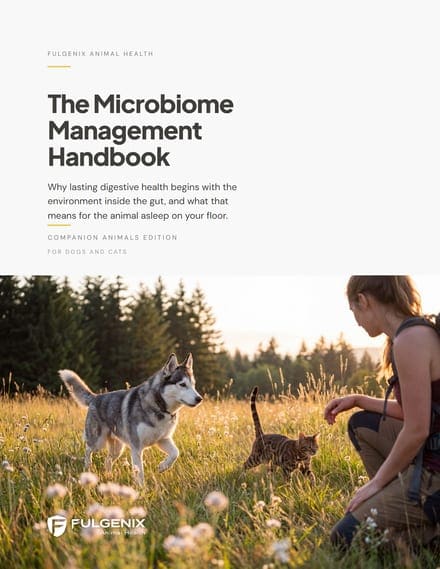
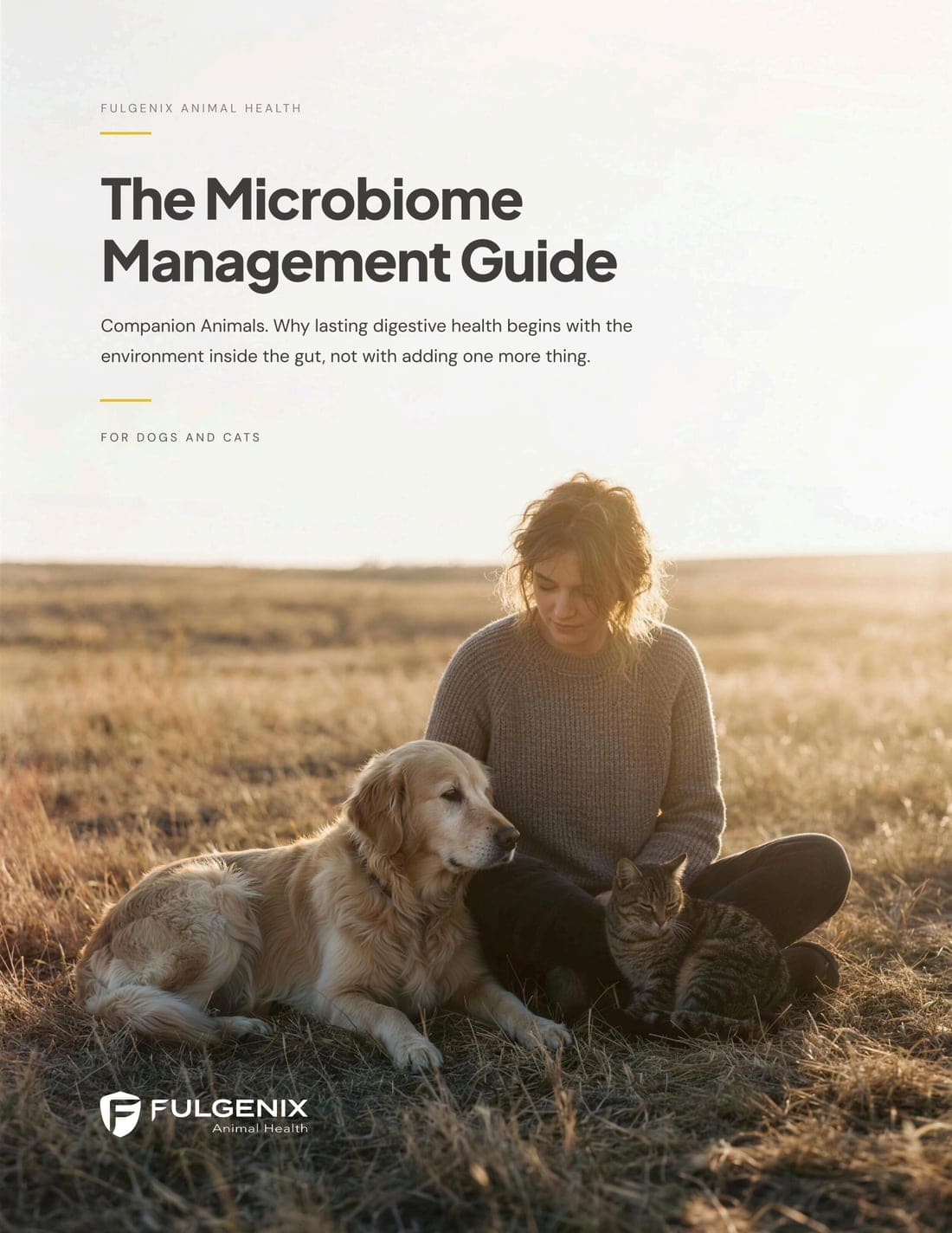
Cover of The Microbiome Management Guide, Companion Animals

Coming soon · Fulgenix

The Microbiome Management Guide

Companion Animals

Why lasting digestive health begins with the environment inside the gut, not with adding one more thing.

10 pages

Handbook

Bring companion-animal expertise to the work.

We welcome contributions to educational review, evidence interpretation and the development of relevant evaluations for dogs and cats.

Associated brand. Fulgenix, run by the project’s founders, sells products for dogs and cats. No study on this page tested a Fulgenix product.

How the project relates to its brands

Sources and further reading

  1. Rubin SI. Introduction to digestive disorders of dogs. Merck Veterinary Manual, dog owners. Reviewed 2018. www.merckvetmanual.com/dog-owners/digestive-disorders-of-dogs/introduction-to-digestive-disorders-of-dogsThe parts of the canine digestive tract.
  2. He W, Connolly ED, Wu G. Characteristics of the digestive tract of dogs and cats. Advances in Experimental Medicine and Biology 1446:15 to 38. 2024. pubmed.ncbi.nlm.nih.gov/38625523/Dogs as facultative and cats as obligate carnivores; dogs’ greater capacity for starch; the large intestine as a site of fermentation of undigested fibre and protein and of water absorption, with gut microbes affecting faecal quality.
  3. Oregon State University. Principles of Animal Nutrition: gastrointestinal tract, digestive organs and processes. open.oregonstate.education/animalnutrition/chapter/gastrointestinal-tract/Cats as carnivores that need animal protein and fats in their diets.
  4. Lin CY, Jha AR, Oba PM, et al. Longitudinal fecal microbiome and metabolite data demonstrate rapid shifts and subsequent stabilization after an abrupt dietary change in healthy adult dogs. Animal Microbiome 4:46. 2022. doi.org/10.1186/s42523-022-00194-9The canine diet-transition study.
  5. Li Q, Pan Y. Differential responses to dietary protein and carbohydrate ratio on gut microbiome in obese vs. lean cats. Frontiers in Microbiology 11:591462. 2020. doi.org/10.3389/fmicb.2020.591462The feline dietary study.
  6. Móritz AV, Farkas O, Jerzsele Á, Palkovicsné Pézsa N. Protective Effects of Humic Acid on Intestinal Barrier Dysfunction and Inflammatory Activation in Canine Cell-Based Models. Animals 16(2):173. 2026. doi.org/10.3390/ani16020173The laboratory cell study: a single dog’s immune cells, and a pig intestinal cell layer.

Prepared by Carbon Biome Project, 19 October 2026; revised 22 October 2026. External scientific review of this page has not been completed.

The waiting list

Join the waiting list

Leave your email and we will send it to you when it is ready.

One email when your edition is ready. Nothing else.