

About Carbon Biome Project
The whole cycle, studied in the open.
Carbon Biome Project studies humic and fulvic substances within the organic matter living things leave behind: what they are, how they behave in soil and water, and what they do, if anything, in the living systems that grow on that ground and eat from it. It publishes the Microbiome Management Framework, keeps an evidence library that shows its gaps, and prepares the reference works that apply both.
The starting point
Observations worth understanding more carefully.
The project grew from the founders’ work with humic and fulvic preparations and their interest in reported changes across different settings. Those experiences raised questions about the role of the surrounding environment, microbial activity and biological function.
Carbon Biome Project provides a place to examine those questions through relevant literature, accessible publications and documented observations.
The intention is to make the reasoning clearer: what is known, what has been observed, what might explain it and what needs further investigation.
An observation can be the beginning of an investigation.
The founders.
Carbon Biome Project was founded by Aaron Oram and Leah Oram, who also work in its associated commercial brands, set out below under Support and relationships.
They are responsible for the framework, the evidence library and the publication series.
The work today
Building a foundation people can examine.
The project’s current focus is explaining the framework, developing publications and organising the evidence relevant to its questions.

The framework
Define the organising principles, clarify the terminology and explain how the approach applies within different living systems.
Read the framework
The publication series
Create guides and handbooks that connect biological understanding, research and practical context for particular audiences.
See the publication seriesThe evidence library
Identify relevant sources and distinguish published findings, project research and field observations through structured summaries.
Open the evidence libraryThe direction
The questions guiding our work.
The project is organised around questions the evidence has not settled. Each is stated where the evidence stops, and each is a place a contributor can start.
Do humic and fulvic materials act in a gut the way they act at a root?
Measured at the root in rice and wheat. No record in this collection has measured it in an animal or a person.
Do alkali-extracted fractions represent organic matter as it exists in soil?
Argued over by leading soil scientists. This site keeps the argument in view.
Which preparation, dose and route produced each measured response?
Every record names them, and a finding is not assumed to carry over to another material, species or route.
Which parts of a humic or fulvic material do microbes use as carbon?
Measured one material and one soil at a time. Stable-isotope probing is one method that could answer it.
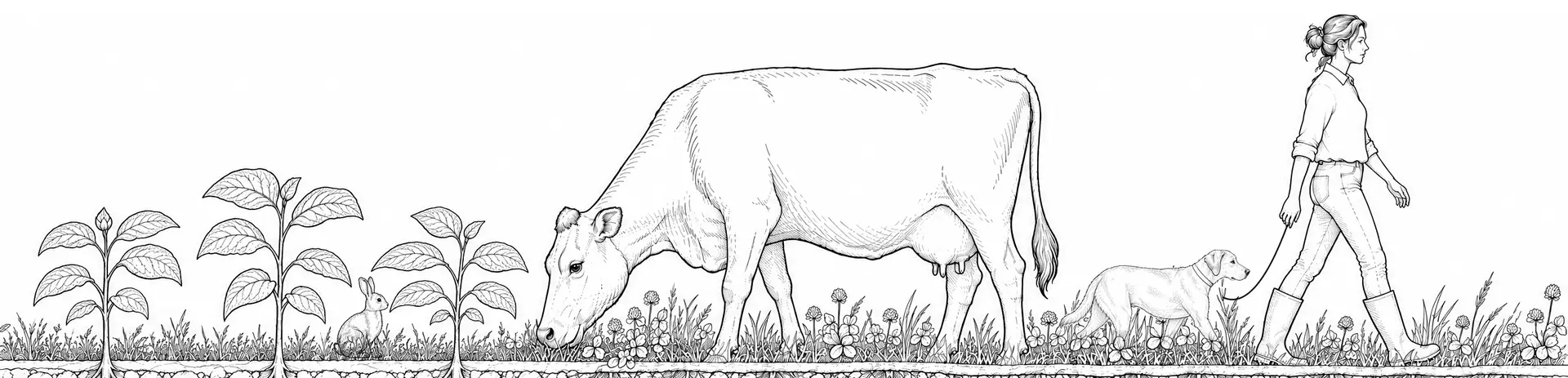
See the cycle from a field to a mineral grain
How the work will improve
As the project develops, its priorities are to strengthen the educational material, improve interpretation of the evidence and create opportunities for well-designed evaluation.
- 01
Professional contribution
Bring relevant expertise into publication review, evidence interpretation and the development of research questions.
- 02
Clearer evaluations
Develop questions and methods that help distinguish reported changes from effects demonstrated under defined conditions.
- 03
Continuing refinement
Update explanations and publications as relevant evidence, review and experience improve the work.
Shared questions can connect disciplines. Progress still depends on careful work within the particular species, material and environment being examined.
Contributing expertise
Expertise should have a clear responsibility.
The project defines three contributor roles, so that every specialist’s responsibility is stated. Responsibilities may include reviewing publications, interpreting research, advising on practical relevance or helping design evaluations.
Contributor profiles will identify the work each person has undertaken and the scope of their involvement.
Publication reviewer
Reviews the accuracy and interpretation of an identified publication or edition.
Technical adviser
Contributes expertise to a defined topic, application or project question.
Research contributor
Participates in specified research activities such as study design, execution or analysis.
We are seeking professional contributors. Confirmed contributors will be introduced alongside their specific work.
Support and relationships
The commercial context is part of the picture.
Carbon Biome Project is connected to commercial brands working in the areas it explores. The founders’ commercial involvement is relevant context for understanding the project and its publications.
Association with the project does not, by itself, establish the performance of a product. Product-specific conclusions require evidence relevant to that formulation and application.
| Brand | Area |
|---|---|
| Humequine | Horses |
| Fulgenix | Companion animals |
| Fulgenix Farms | Livestock and aquaculture |
| IONICAID | Humans |
| Quad AG | Soil and plants |
Read the work. Help improve it.
Read the framework, examine the evidence or bring relevant expertise to a question the project is developing.