
Microbiome Management in aquaculture

In aquaculture, the animal and its water are one setting.

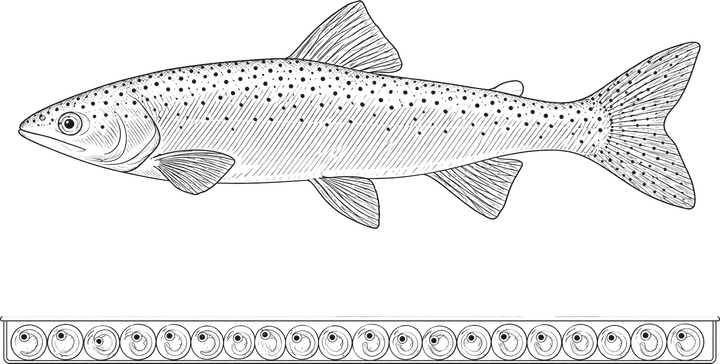
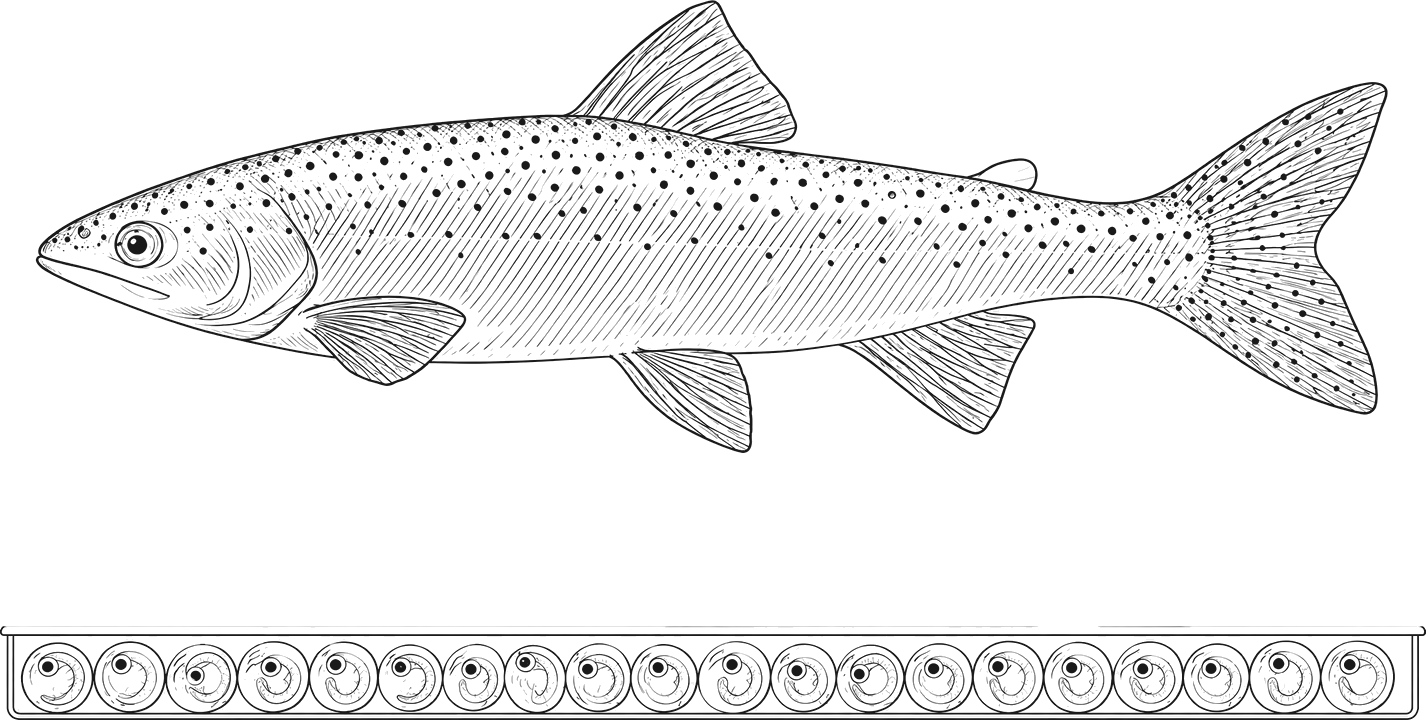
A trout begins as an egg in cold, moving water. In a hatchery that water is piped in, its flow is set and it can be dosed; the eggs rest in trays or jars, and the young fish are raised in tanks and fed. Each of those settings asks its own question.

Illustration. Eggs enlarged, not to scale.

Why this setting matters

A trout, and the microbial world inside its gut.

A fish lives inside its water. The water touches the egg, then the gills and skin, and the feed arrives through it. A hatchery manages that water, so the setting itself can be measured and changed.

Environmental conditions

Resources, physical conditions and management.

Microbial activity

Functions and interactions within the community.

Observable function

What can be measured in the host or wider system.

A rainbow trout in outline above a row of eggs in a tray. A small box marks the fish's intestine.
  1. The trout intestine

    Magnified view of the trout intestineThe intestinal wall along the top with its mucosal folds, each lined with mucus. Below, feed particles with bacteria attached to their surfaces; the community is sparser than in a mammal's hindgut. A green tint marks the feed particles bacteria attach to; the trout digests them mainly with its own enzymes.abcd
    • a Gut wall and folds
    • b Feed particle
    • c Bacteria
    • d Mucus layer

    Observable function Survival to hatch and weight gain

  1. Survival to hatch and weight gain
Illustration. Magnified views are conceptual and not to scale.

Why this system is investigated. Because a fish lives inside its water, a humic or fulvic material can be given to the egg’s water or to the feed, and those are different questions. The two trout studies in this collection, one in incubation water and one in feed, are read apart, and feed intake and conversion were not measured in the feeding study.

What is happening here

From egg to juvenile, three different waters.

The same kind of material can reach a trout three ways. Each is its own setting, with its own microbes and its own measurements, so a result in one does not carry to the next.

  1. Eggs in incubation water: stacked trays and an upright jar, with water flowing through each

    Incubation water

    Fertilisation to hatch.

    Groundwater flows through stacked trays or upright jars of eggs, in the dark. A preparation dosed here meets the eggs and the microbes living in that water.

    In this collection. One study, Chiasson, Kirk and Huyben 2023.

  2. Juvenile trout in a rearing tank, with water flowing in at one side and out through a standpipe

    Rearing water

    After hatching.

    Young fish grow in tanks of flowing water. The water entering and leaving each tank carries its own microbial community, separate from the one in the fish.

    In this collection. No record applies a preparation to rearing water. The 2026 feeding trial ran in flow-through tanks.

  3. A juvenile trout above feed pellets sinking through the water; each pellet carries a coating, drawn dashed

    Dietary use

    Through the feed.

    A preparation coated onto the pellets is eaten, and meets the intestine, its folds and the microbes living there. The trout digests its feed mainly with its own enzymes.

    In this collection. One study, Chiasson and colleagues 2026.

Schematic drawings, not to scale. Water is drawn in green; the pellet coating is drawn dashed.

A water sample does not describe the fish’s intestinal community, and an intestinal measurement does not describe the water.

The framework in this setting

One application: eggs in incubation water.

The framework keeps the setting, the microbes and the measurement in view together, without assuming that one explains another. Here it is applied to the 2023 incubation study.

  1. Environmental conditions

    Groundwater at 9 °C, in the dark, flowing through trays or jars, with the product dosed continuously.

  2. Microbial activity

    Which bacteria are in the incubation water, and whether visible fungus grows on the eggs.

  3. Observable function

    Survival of the eggs to the eyed stage and to hatch.

Observe, compare and reassess.The jars did not repeat the tray result, which sends the question back to the conditions.

Digestive Stability belongs to discussions of digestive function, as in the feeding study. Egg survival and water-system performance need their own outcome descriptions.

The humic and fulvic research

What went into the water, and what went into the feed.

Humic and fulvic materials are mixtures, not single molecules, and each study names its own source and dose. These two preparations come from the same manufacturer, but they are different materials applied by different routes.

In incubation water, 2023

Material
An aqueous extract of oxidised lignite, called humic acid in the paper.
Route
Dosed continuously into the incubation water, from fertilisation to hatch.
Dose
0.005 mL per litre of water (5 mg/L in the published correction). A dose of the liquid product, not a measured humic acid concentration.
Question
Microbial control: does the water’s bacterial community change, does visible fungus grow, and do more eggs hatch?

In feed, 2026

Material
A humic and fulvic acid preparation derived from oxidised leonardite.
Route
Top-coated onto a commercial diet, fed for 140 days.
Dose
5, 10 or 15 mL per kg of feed. At 5 mL/kg the feed carried 0.183 g/kg humic acid and 0.153 g/kg fulvic acid.
Question
Growth, the structure of the intestine and the gut’s microbial community.

What is established

Two studies, each read in its own setting.

Every result below carries the place it was measured: the water community, the intestine, the eggs in their incubator, or the animal itself.1,2,3

  • Water community
  • Incubation observation
  • Intestine
  • Animal outcome

2023 · Incubation water · Rainbow trout eggs

The same dose in two kinds of incubator.

Eggs were incubated in groundwater with or without the product, in stacked trays and in jars, and the experiment was repeated over three weeks with four tray units and two jar units per group each week.

Stacked trays

Animal outcome Survival to hatch

Higher with the product (P ≤ 0.001).

Incubation observation Visible fungus

Absent in treated trays, present in controls. Observed by eye, not quantified.

Water community Bacteria in tray water

Lower diversity, with fewer Flavobacterium and Aeromonas, by relative abundance rather than load.

Jars

Animal outcome Survival to hatch

No statistically supported difference (P = 0.699).

The authors’ explanation

Humic acid bound to manganese precipitate in the groundwater settled on the embryos in the jars.

Survival drawn to the reported means, on a scale of 0 to 100 percent. The vessels are schematic, not to scale.

The dose, as corrected. 0.005 mL per litre of water (5 mg/L in the published correction), in both vessels. The original article printed 0.005 mg/L; the published correction replaced it throughout, and the authors state that the error does not change the conclusions. The figure is a dose of the liquid product, not a measured humic acid concentration.
2026 · Feed · Juvenile rainbow trout

Four diets in twelve tanks.

Juvenile trout, 22.9 g at the start, were fed one of four diets for 140 days in 300 L flow-through tanks: three tanks per diet and 60 fish per tank. The tank, not the fish, is the experimental unit.

Animal outcome Final body weight after 140 days

Heavier at all three rates than the control (P < 0.001), and longer, with no difference among the rates.

Drawn from zero on a 160 g scale. The tick on each bar marks the 22.9 g starting weight.

Intestine Measured in the gut

  • Gut pH No difference.
  • Distal villus length Not different from the control.
  • Oedema and inflammation scores No difference by rate.
  • Microbial diversity Higher at 15 mL/kg only (Shannon); between-group composition did not differ.

Not measured

Feed intake and feed conversion. The fish were fed with a surplus, so the trial cannot say whether the heavier fish ate more or used their feed more efficiently. A heavier fish is not a feed-efficiency result.

In this collection. Two rainbow trout studies, one in incubation water and one in feed, and no record of a preparation applied to rearing water.

What is being investigated

What these two studies leave open.

Each result answers a narrow question well and raises the next one.

  • Other incubators and waters

    The jars did not repeat the tray result. Whether the tray result holds in other incubator designs and water chemistries is untested.

  • Microbes and survival

    Tray water held fewer Flavobacterium and Aeromonas. Whether that shift relates to the fungus and survival results, or ran alongside them, is not shown.

  • Weight and feed

    The fed fish ended heavier. Feed intake and feed conversion were not measured, so how they grew heavier is open.

  • Other species and stages

    Both studies are rainbow trout. A result does not transfer to salmon, shrimp or grow-out fish without its own study.

For practitioners: what to record

What to document in an aquaculture evaluation, so that the setting is measured as well as the response.

Measure the setting as well as the response.

Begin with the application and question. Choose observations that describe the starting conditions, exposure and outcomes without confusing them.

What to document in an aquaculture evaluation
AreaWhat to document
PopulationSpecies, life stage, initial size or egg stage, source and relevant history.
SystemEquipment, water connections, flow or exchange, stocking and management.
WaterRelevant measurements, methods, sampling locations and times.
PreparationIdentity, composition where available, application route and exposure.
FeedingFeed formulation, delivery and intake information where measured.
OutcomesApplication-specific survival, growth, intestinal, microbial or system measurements.
Concurrent changesHandling, treatments, equipment changes and other interventions.

The independent experimental unit may be a tank, incubator or water system rather than each animal or egg. Shared water connections and repeated measurements need to be considered in study design.4

More animals within one shared system do not automatically provide more independent replication.

Where to learn or contribute

The aquaculture publications.

Cover of The Microbiome Management Guide, Aquaculture Operations Edition

Coming soon · Fulgenix Farms

The Microbiome Management Guide

Aquaculture Operations Edition

Why productive, resilient aquaculture systems begin with the biological environments inside and around the animal.

17 pages

Handbook

Bring aquatic expertise to the work.

We welcome contributions to publication review, evidence interpretation and evaluations that reflect the realities of aquatic production systems.

Associated brand. Fulgenix Farms, run by the project’s founders, sells products for aquaculture. The 140-day feeding trial on this page tested the formulation it sells; the incubation study tested a preparation from the same manufacturer. That manufacturer funded the incubation study and co-funded the feeding trial.

How the project relates to its brands

Sources and further reading

  1. Chiasson M, Kirk M, Huyben D. Microbial control during the incubation of rainbow trout (Oncorhynchus mykiss) eggs exposed to humic acid. Frontiers in Aquaculture 2:1088072. 2023. doi.org/10.3389/faquc.2023.1088072The egg-incubation study.
  2. Chiasson M, Kirk M, Huyben D. Corrigendum: Microbial control during the incubation of rainbow trout (Oncorhynchus mykiss) eggs exposed to humic acid. Frontiers in Aquaculture. 24 July 2023. doi.org/10.3389/faquc.2023.1252406The published correction to the study exposure.
  3. Chiasson M, Easton A, Snyman H, Huyben D. Dietary humic and fulvic acid supplementation improves growth and modulates intestinal morphology and gut microbiome in rainbow trout. North American Journal of Aquaculture. 2026. doi.org/10.1093/naaqua/vrag026The dietary study.
  4. Seo S, Jeon S, Ha JK. Guidelines for experimental design and statistical analyses in animal studies submitted for publication in the Asian-Australasian Journal of Animal Sciences. Asian-Australasian Journal of Animal Sciences 31:1381 to 1386. 2018. doi.org/10.5713/ajas.18.0468Why the tank, pen or shared system can be the experimental unit.

Prepared by Carbon Biome Project, 19 October 2026; revised 22 October 2026. External scientific review of this page has not been completed. Citing university research does not imply institutional endorsement of the project.

The waiting list

Join the waiting list

Leave your email and we will send it to you when it is ready.

One email when your edition is ready. Nothing else.