
Peer-reviewed publication · Aquaculture · In the living system
Humic acid in incubation water was followed by higher hatch survival in trays, but not in jars.
- Incubation water
With the humic acid product in the incubation water, trout eggs in stacked trays hatched better and showed no visible fungus, but eggs in jars did not hatch better.
Chiasson, Kirk and Huyben, 19 January 2023. Frontiers in Aquaculture 2:1088072. Manufacturer-funded study.
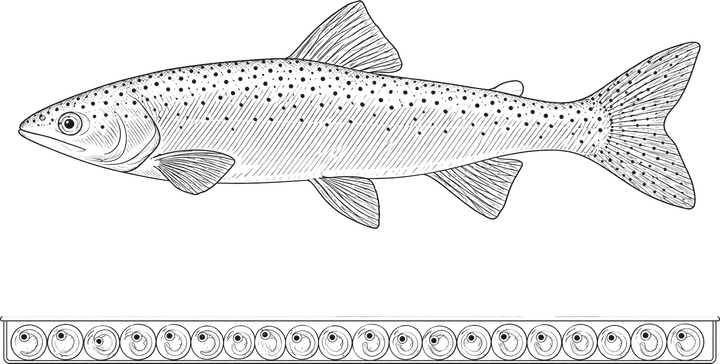
Scope, material and route
- Studied
- Rainbow trout (Oncorhynchus mykiss), fertilisation to hatch
- Design
- Controlled experiment, repeated over three weeks, in stacked trays and in jars
- Setting
- Ontario Aquaculture Research Centre, groundwater at 9 °C in the dark
- Material
- An aqueous extract of oxidised lignite. Named in the paper as AC Aqua, MTS Environmental Inc., which funded the study and supplied the product.
- Route
- Continuously dosed into the incubation water
- Exposure
- 0.005 mL of the product per litre of water (5 mg/L in the published correction). Study exposure, not application guidance.
Correction. The published correction states that the dose was 0.005 mL of the humic acid product in 1 L of water, given as 5 mg/L, replacing 0.005 mg/L throughout the article. The figure is a dose of the liquid product, not a measured humic acid concentration. The authors state that the error does not change the conclusions. This record uses the corrected dose.
Study design
Stacked trays
12 tray replicatesPer group: four a week, for three weeks.
- Survival to hatch77.2 ± 10.4 against 55.5 ± 16.1 percent
- Visible fungusAbsent in treated trays, present in controls; observed, not quantified
- Water bacteriaLower diversity; Flavobacterium and Aeromonas lower in relative abundance
Jars
6 jar replicatesPer group: two a week, for three weeks.
- Survival to hatch62.5 ± 27.6 against 70.9 ± 20.6 percent
- The authors' explanationHumic acid bound to manganese precipitate settling on the embryos
More study details
- Research question
- Does humic acid in incubation water change fungal growth, bacterial communities and survival of rainbow trout eggs?
- Experimental unit
- Incubator units: four tray replicates and two jar replicates per group each week, so 12 tray and 6 jar replicates per group over the three weeks
- Comparator
- Untreated groundwater
- Outcomes measured
- Survival to eyed stage and hatch; visible fungal growth; water bacterial communities by 16S rRNA sequencing
Findings
Researchers incubated rainbow trout eggs in groundwater with or without the humic acid product at 0.005 mL per litre of water (5 mg/L in the published correction), from fertilisation to hatch, in two systems: stacked trays and jars. In trays, visible fungus was absent in treated units and present in controls, and survival to hatch was higher, 77.2 against 55.5 percent. In jars, survival did not differ, 62.5 against 70.9 percent; the authors attribute this to humic acid bound to manganese precipitate settling on the embryos. Treated tray water had lower bacterial diversity, with fewer Flavobacterium and Aeromonas. The two systems gave different results, so the finding applies to the incubation setting, not to feeding or general water treatment.
| Outcome | Comparison or result | Interpretation |
|---|---|---|
| Survival to hatch, trays | 77.2 ± 10.4 against 55.5 ± 16.1 percent (P ≤ 0.001) | Higher with humic acid |
| Visible fungus, trays | Absent in treated trays; present in controls | Observed visually, not quantified |
| Survival to hatch, jars | 62.5 ± 27.6 against 70.9 ± 20.6 percent (P = 0.699) | No statistically supported difference |
| Water bacterial communities, trays | Lower diversity; Comamonadaceae higher, Flavobacterium and Aeromonas lower | Relative abundance in water, not microbial load |
Values are humic acid first, control second, ± standard deviation, as reported. Values are extracted from the source as reported; no raw data were available.
Interpretation and limits
What this record supports
Higher hatch survival and absence of visible fungus in stacked-tray incubation with the humic acid product at 0.005 mL per litre of water (5 mg/L in the published correction) in this facility.
What remains uncertain
- Systems disagree. Jars showed no survival benefit, which the authors link to manganese precipitate in the groundwater.
- Measurement. Fungus was assessed visually; bacteria were described by relative abundance from water filtered at 1.5 µm, which may miss smaller cells.
- Transfer. An incubation-water result does not establish effects of dietary use or of other water applications.
Which part of the framework it informs
Environmental conditions
The physical, chemical and management context.
This record informs this area.Microbial activity
What microbial communities do within that context.
This record informs this area.Observable function
What can be observed or measured in the host or wider system.
Source, funding and review
- Source type
- Peer-reviewed publication (with a published correction)
- Associated products
- The study tested a preparation from the manufacturer that produces the formulations sold by Fulgenix Farms. Equivalence to a specific Fulgenix Farms product is not documented in this record.
- Funding and relationships
- Funded by the manufacturer of the tested preparation, which also supplied it. The authors state that the funder had no other involvement.
- Review status
- Prepared as an editorial summary. External scientific review has not been completed.
- What was read
- Full text and correction notice read on the publisher's pages.
- Original title
- Microbial control during the incubation of rainbow trout (Oncorhynchus mykiss) eggs exposed to humic acid
- Authors
- Chiasson M, Kirk M, Huyben D
- Publication
- Frontiers in Aquaculture 2:1088072, 19 January 2023
- DOI
- 10.3389/faquc.2023.1088072
- Correction notice
- 10.3389/faquc.2023.1252406
- Summary prepared by
- Carbon Biome Project
- Date added
- 19 October 2026
- Cite this summary
- Carbon Biome Project. Humic acid in incubation water was followed by higher hatch survival in trays, but not in jars. Evidence library record, added 19 October 2026. carbonbiomeproject.com/evidence/chiasson-2023-humic-acid-trout-egg-incubation/
Related records
Trout fed a humic and fulvic top‑coating over 140 days grew heavier than controls.
Chiasson et al., 2026