
Microbiome Management in human systems

A living ecosystem within everyday life.

Breakfast, a walk, a busy week. Through all of it, food moves through a digestive tract that the body runs and a community of microbes shares.

Why this setting matters

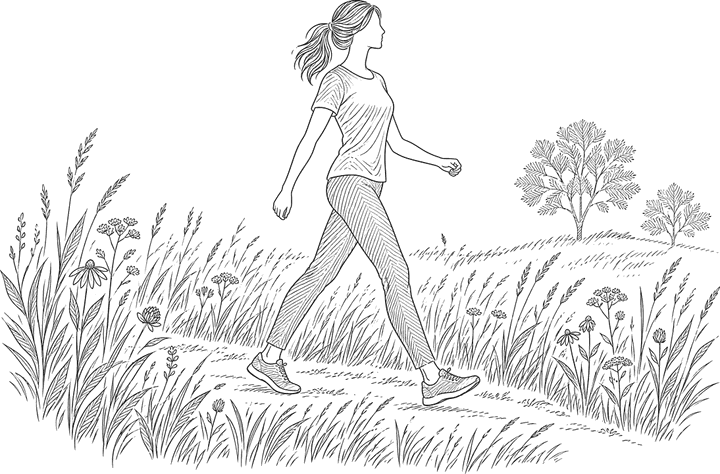
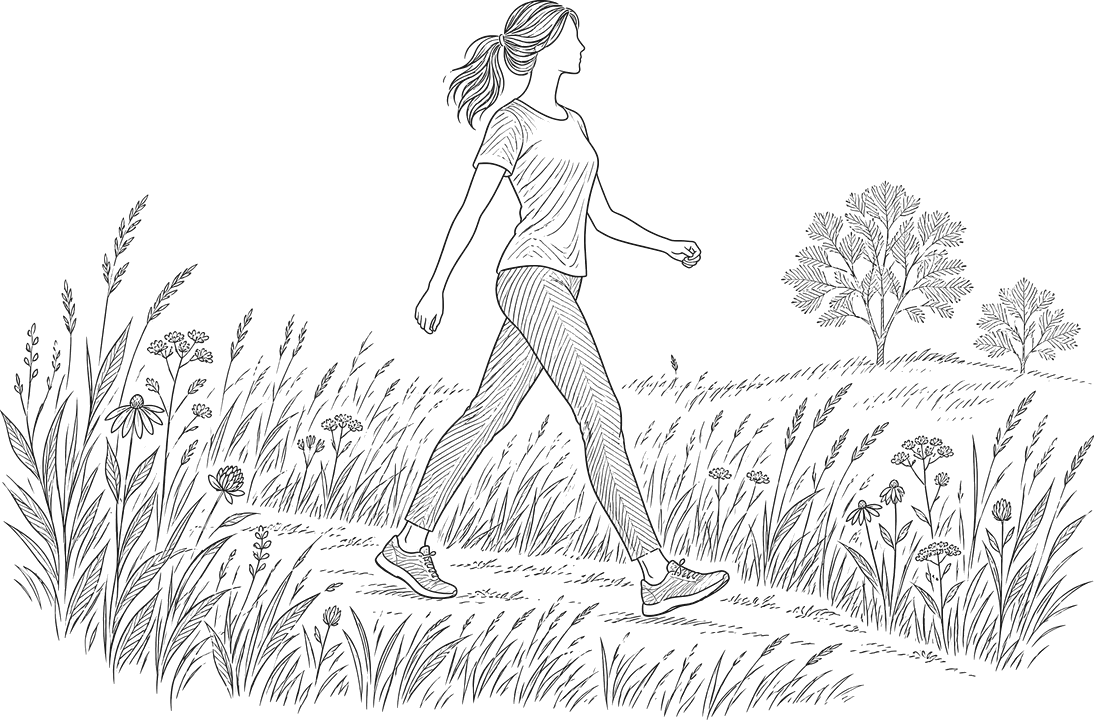
A person walking, and the microbial world inside.

A person walking, and the microbial community in her large intestine. What she eats, and how her days run, shape the conditions that community lives in.1

Environmental conditions

Resources, physical conditions and management.

Microbial activity

Functions and interactions within the community.

Observable function

What can be measured in the host or wider system.

A woman walking along a meadow path. A small box marks her lower abdomen, where the large intestine lies.
  1. The large intestine

    Magnified view of the large intestineThe colon wall along the top, lined with mucus whose inner part holds few microbes. Below, fragments of plant fibre, drawn as rows of plant cell walls, with bacteria attached along their surfaces and gathered at their torn ends. A green tint marks the plant fibre that fibre-digesting microbes attach to and break down.abcd
    • a Colon wall
    • b Plant fibre
    • c Bacteria
    • d Mucus layer

    Observable function Stool form and gut transit time

  1. Stool form and gut transit time
Illustration. Magnified views are conceptual and not to scale.

Why this system is investigated. The large intestine is read here the way a root zone or a rumen is: a microbial community living within conditions that diet and daily life set.

The research question concerns preparations: which fulvic material, by which route, with safety and efficacy asked separately. This collection holds one small topical trial and one short oral safety study of a carbohydrate-derived fulvic acid; neither establishes an oral digestive effect, and this library holds no oral efficacy trial.

Food and daily life

It begins with what is on the plate.

Ordinary food carries the material the gut’s microbes live on. One diet study in this collection worked with ordinary food alone.2

  • Plant fibre

    Legumes, seeds, whole grains, nuts, vegetables and fruit. In the study’s fibre group, people added at least 20 g of fibre a day from foods like these.

  • Fermented foods

    Yogurt, kefir, kimchi and other fermented vegetables, vegetable brine drinks and kombucha. The fermented-food group worked up to six servings a day.

  • Daily circumstances

    Routine, travel, illness and medicines change the conditions around the gut too. That is why a useful record of any digestive change starts with the circumstances, not with one ingredient.

Line drawings of everyday food and a week of daily life, not to scale.

What is happening here

Follow a meal through the digestive tract.

The body digests most of a meal itself. Bacteria in the digestive tract help, and in the large intestine they help break down remaining nutrients and make vitamin K.1

Digestive ecology looks at these relationships within the conditions of each part of the tract.

Simplified human digestive tractAn ordered schematic: 1, stomach; 2, small intestine; 3, large intestine, with the small cecum at its start; 4, rectum.12341234

Simplified human digestive anatomy. Not to scale.

  1. 1

    Stomach

    Receives food and participates in its processing.

  2. 2

    Small intestine

    Absorbs most of the nutrients in food, with water, into the bloodstream.

  3. 3

    Large intestine

    Absorbs water. Its bacteria help break down remaining nutrients, and what is left becomes stool.

  4. 4

    Rectum

    Stores stool before elimination.

Measurements from one compartment do not describe the whole digestive system. A stool sample tells you about the large intestine’s contents, not a complete account of digestion or microbial function.

The framework in humans

One application: a change in diet.

Carbon Biome Project uses Digestive Stability as a working concept for appropriate digestive function and adaptation through change. It helps organise questions; it is not a recognised diagnosis, a validated clinical score or a substitute for medical assessment.

  1. Digestive conditions

    A person adds fermented foods over four weeks, then keeps them up, with the rest of the diet and routine written down.

  2. Microbial activity

    Stool samples taken before, during and after show how the gut community’s diversity and make-up move.

  3. Human observations

    How digestion feels, in ordinary words, alongside any measures a clinician takes.

Observe, interpret and reassess.A change shows what to look at next. It does not say what caused it.

A symptom change does not identify its cause. A microbial measurement does not automatically establish a meaningful clinical improvement.

The humic and fulvic research

The material matters as much as the name.

“Fulvic acid” on a label does not say where the material came from. The two human studies of a fulvic material in this collection used a carbohydrate-derived one, which is a different thing from the soil- and lignite-derived materials described elsewhere on this site.

In the human studies here

Carbohydrate-derived fulvic acid

Named in both papers as carbohydrate-derived: made from a carbohydrate starting material, not extracted from soil, peat or lignite. One study applied it to the skin in a cream; the other gave it by mouth.

Elsewhere on this site

Soil- and lignite-derived humic and fulvic materials

Extracted from soil organic matter, peat or oxidised lignite. Mixtures whose make-up depends on the source and the extraction. No record in this collection tests one in people.

Results for the carbohydrate-derived material do not transfer to soil- or lignite-derived material, and a result on the skin does not establish an effect in the gut.

What to establish about a studied preparation
What to establishQuestion
SourceHow was the material obtained?
PreparationHow was it processed and characterised?
FormulationWhat other ingredients were present?
RouteWas it ingested, applied topically or studied another way?
ExposureWhat quantity and duration were examined?
PopulationWho participated, and who was excluded?
OutcomeWas the study examining tolerability, biomarkers, symptoms or another endpoint?

What is established

Three kinds of human research, kept apart.

Diet studies, skin studies and studies of a preparation taken by mouth ask different questions. Each group below names its material and route first.

  1. Diet and background biology

    Material No humic or fulvic material

    Route Whole foods

    Background biologyHuman study · Dietary intervention

    Two diets moved the gut community along different paths.

    In healthy adults, a high-fermented-food diet was followed by rising gut microbial diversity and lower levels of 19 of 93 inflammatory proteins. A high-fibre diet shifted microbial function without raising diversity. The study’s primary outcome did not change in either group.

    Limitation. 18 analysed adults per arm, with no control arm and no blinding; diversity and inflammatory markers are measurements, not a health score.

    Funding. Donor and institutional funding; several authors hold company interests.

    Interpretation. Background biology about diet and the gut community. It tested no humic or fulvic material and is not a treatment for any digestive condition.

    Study design
    Randomised, open-label comparison of two diets, without a control arm
    Material
    No humic or fulvic material tested; high-fibre or high-fermented-food diet
    Source
    Wastyk et al., 2021. Gut-microbiota-targeted diets modulate human immune status
    Read evidence summary
  2. Topical fulvic research

    Material Carbohydrate-derived fulvic acid, 3.5 percent in an emollient

    Route On the skin

    Published studyHuman study · Topical application

    A small trial tested a cream on the skin.

    In 36 people with eczema, the investigator rated a cream containing a carbohydrate-derived fulvic acid better than placebo over four weeks. Both groups improved within themselves on severity and redness.

    Limitation. A small exploratory trial of 36 people, applied to the skin; it says nothing about taking fulvic acid by mouth.

    Funding. No funding source stated; no conflicts reported.

    Interpretation. A result on the skin, for one carbohydrate-derived material. It does not establish an oral or digestive effect.

    Study design
    Randomised, double-blind, placebo-controlled trial
    Material
    Carbohydrate-derived fulvic acid, 3.5 percent in an emollient
    Source
    Gandy, Snyman and van Rensburg, 2011. Randomized, parallel-group, double-blind, controlled study to evaluate the efficacy and safety of carbohydrate-derived fulvic acid in topical treatment of eczema
    Read evidence summary
  3. Oral preparation research

    Material Carbohydrate-derived fulvic acid, 3.8 percent oral preparation

    Route By mouth

    Published studyHuman study · Early-phase preparation research

    An early-phase study looked at short-term tolerability.

    Of 30 men enrolled, 21 completed exposures of a week or less. No serious adverse events were reported; mild gut and throat effects appeared at the top dose.

    Limitation. 30 men enrolled and 21 completed, with no exposure longer than seven days; the efficacy measure was a single skin-prick response.

    Funding. No funding source stated; the manufacturer is not named.

    Interpretation. Short-term tolerability of one preparation. It is not evidence of efficacy or of long-term safety, and it does not transfer to other fulvic materials or to any commercial formulation.

    Study design
    Phase 1 dose escalation in two randomised groups, then a double-blind, placebo-controlled crossover
    Material
    Carbohydrate-derived fulvic acid, 3.8 percent oral preparation
    Source
    Gandy et al., 2012. Phase 1 clinical study of the acute and subacute safety and proof-of-concept efficacy of carbohydrate-derived fulvic acid
    Read evidence summary

How long each exposure lasted

Drawn to scale on 0 to 10 weeks. The diet study added a three-week baseline before and four weeks of free choice after.

What the oral study can speak to

  • Reported

    Short-term tolerability

    No serious adverse events in 21 men over a week or less; mild gut and throat effects at the top dose.

  • Not established

    Efficacy

    One skin-prick allergy measure in a small crossover. No digestive outcome was studied.

  • Not studied

    Long-term safety

    No exposure lasted longer than seven days.

In this collection. One topical trial and one short oral safety study, both of a carbohydrate-derived fulvic material, one dietary background record, and no oral efficacy trial.

What is being investigated

The questions the human record leaves open.

  • An effect by mouth

    Whether any oral humic or fulvic preparation changes a digestive outcome in people needs an efficacy trial of that preparation.

  • What happens in the gut

    What becomes of an ingested humic or fulvic material in the human gut is not shown by any record in this collection.

  • Whether diet changes last

    The diet study followed 10 weeks of intervention and four of free choice. Whether its microbial changes persist longer is unknown.

  • One material to another

    Each source of humic or fulvic material needs its own study. A carbohydrate-derived result does not answer the question for soil- or lignite-derived material.

For practitioners: what to record

Useful context for a conversation about digestive concerns: the circumstances, and what changed.

A useful question starts with the circumstances.

Dietary patterns, recent changes, medications and health history provide context for digestive observations. Research interpretation also depends on who participated and what was measured.

  • Dietary pattern

    Consider the overall pattern, foods, supplements and recent changes rather than attributing an observation to one ingredient immediately.

  • Daily circumstances

    Record relevant changes in routine, travel and other circumstances surrounding the observation.

  • Health and care

    Keep diagnoses, prescribed treatments and professional recommendations within the discussion.

  • Starting point

    Identify the person’s baseline and distinguish a change from a single isolated observation.

A clearer record can support a better clinical conversation.

When discussing digestive concerns, describe the pattern, timing and surrounding circumstances. Separate what was experienced from what is believed to have caused it.

Useful context for a conversation about digestive concerns
AreaUseful context
TimingWhen a change began and whether it persists or recurs.
Food and supplementsRelevant intake and recent changes.
Digestive experiencesSymptoms described in ordinary terms, including frequency and impact.
Daily circumstancesRelevant changes in routine or other conditions.
CareDiagnoses, medications and professional recommendations.
Concurrent changesOther interventions occurring during the same period.

Persistent, worsening or concerning symptoms need medical assessment. Do not delay care or change prescribed treatment based on this educational framework or a supplement experience.

Where to learn or contribute

Read further in the framework and the science.

Catalogue note: the publication series has no human edition.

The framework and the science pages apply across living systems.

Bring human-health expertise to the work.

We welcome contributions to educational review, evidence interpretation and the development of appropriate human research questions.

Associated brand. IONICAID, run by the project’s founders, sells products for people. The records on this page do not assess any IONICAID formulation.

How the project relates to its brands

Sources and further reading

  1. National Institute of Diabetes and Digestive and Kidney Diseases. Your digestive system and how it works. www.niddk.nih.gov/health-information/digestive-diseases/digestive-system-how-it-worksBasic digestive anatomy and physiology, and the roles used in the schematic.
  2. Wastyk HC, Fragiadakis GK, Perelman D, et al. Gut-microbiota-targeted diets modulate human immune status. Cell 184:4137 to 4153. 2021. doi.org/10.1016/j.cell.2021.06.019The dietary intervention study. Author manuscript: pmc.ncbi.nlm.nih.gov/articles/PMC9020749.
  3. Gandy JJ, Meeding JP, Snyman JR, van Rensburg CEJ. Phase 1 clinical study of the acute and subacute safety and proof-of-concept efficacy of carbohydrate-derived fulvic acid. Clinical Pharmacology: Advances and Applications 4:7 to 11. 2012. doi.org/10.2147/CPAA.S25784The preparation-specific human study.
  4. Gandy JJ, Snyman JR, van Rensburg CEJ. Randomized, parallel-group, double-blind, controlled study to evaluate the efficacy and safety of carbohydrate-derived fulvic acid in topical treatment of eczema. Clinical, Cosmetic and Investigational Dermatology 4:145 to 148. 2011. doi.org/10.2147/CCID.S23110The topical trial.

Prepared by Carbon Biome Project, 19 October 2026; revised 22 October 2026. External scientific and clinical review of this page has not been completed. Citing the National Institutes of Health does not imply its endorsement of the project.

The waiting list

Join the waiting list

Leave your email and we will send it to you when it is ready.

One email when your edition is ready. Nothing else.