
Handbook · Soil & plants
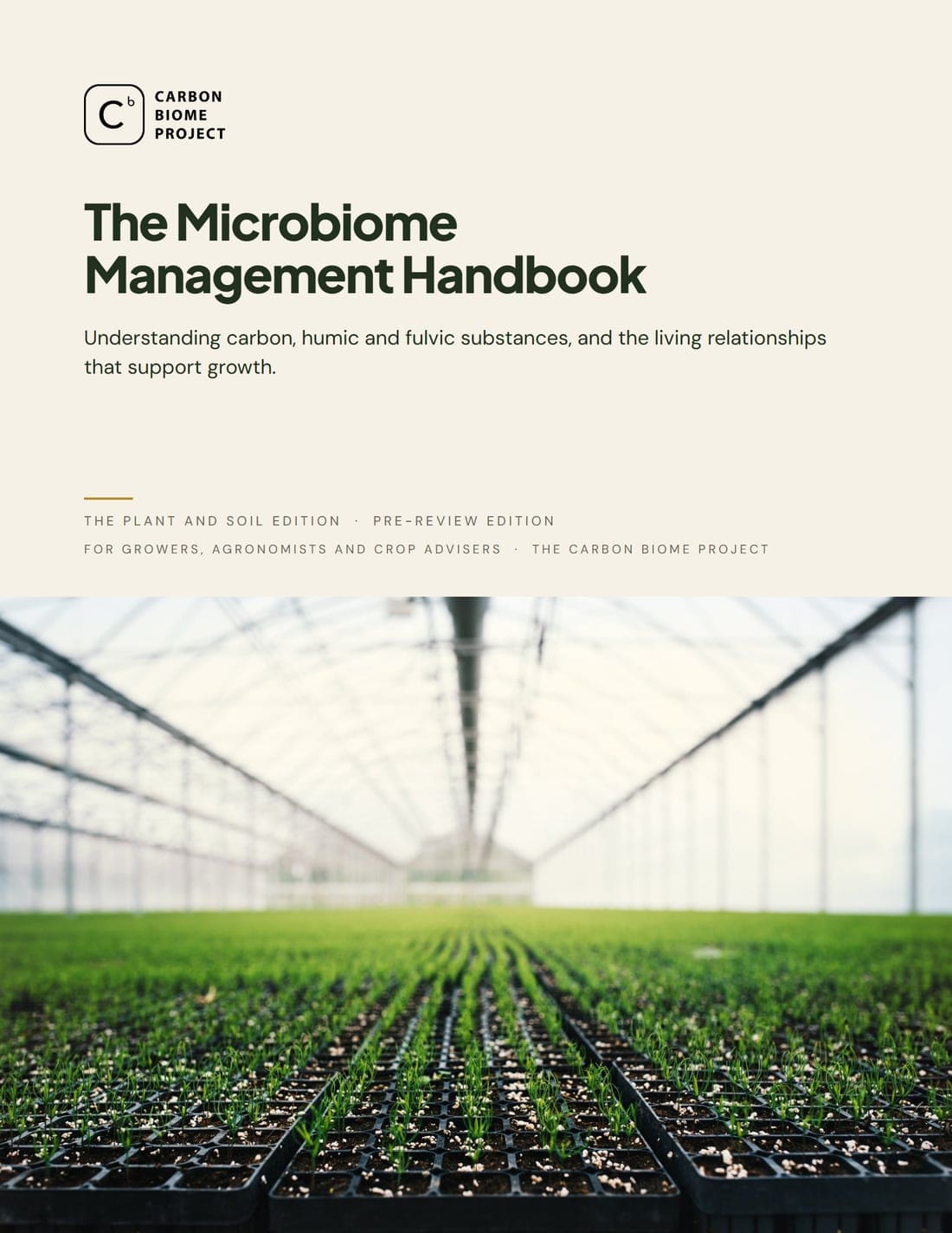
The Microbiome Management Handbook
The Plant and Soil Edition
A handbook for growers, agronomists and crop advisers on carbon, humic and fulvic substances and the living relationships that support plant growth.
This edition is coming soon. Join the waiting list and we will tell you when it is ready.
- Status
- Coming soon
- Date
- 9 October 2026
- Publisher
- Carbon Biome Project
- Review
- External scientific review has not been completed for this edition.
- Length
- 89 pages, PDF
- Living system
- Soil & plants. Field crops, horticulture and controlled‑environment production
What you will learn
- Understand how carbon moves from sunlight through plants into organic matter, and how soil and root microbial communities take part.
- Examine what the terms humic and fulvic describe, how scientists separate them, and how natural material differs from a commercial formulation.
- Explore what plant studies have measured, including mixed findings and the conditions that change a response.
- Consider how to apply the framework in field soils and in soilless and hydroponic systems, from defining a baseline to designing a practical comparison.
Who it is for
Written for growers, agronomists and crop advisers who want the biology and the evidence behind decisions about the root-zone environment. It assumes interest rather than specialist training, and explains technical terms as it goes.
Covers field soils and controlled environments, including living-soil greenhouse production, substrates such as peat, coir and rockwool, and recirculating hydroponic systems. It does not give crop-specific application rates.
Inside the publication
Ten parts, with frequently asked questions and glossary. Open a part to see its chapters.
Part IWhere growth takes root
- 1.A plant is part of a living system
- 2.From sunlight to biological activity
- 3.What happens when living things become organic matter
- 4.The environment around a root
Part IIThe microbial world of plants
- 5.The soil community
- 6.The rhizosphere: where roots influence their surroundings
- 7.Life on the root surface and inside the plant
- 8.Leaves, seeds and the wider plant microbiome
- 9.What makes a microbial community useful?
Part IIIUnderstanding humic and fulvic substances
- 10.Where humic and fulvic substances live
- 11.How scientists separate what you have just met
- 12.From natural material to commercial formulation
- 13.What soil science agrees on, and what remains debated
Part IVThree functions
- 14.Content, availability and the roles carbon plays
- 15.Humic acid: charge, pH and nutrients
- 16.Water, mineral surfaces and the physical environment
- 17.Fulvic acid: the mobile fraction in the soil solution
- 18.Three functions, in two places
Part VWhat the plant does, and what research has measured
- 19.Reading a plant study well
- 20.Roots respond to their environment
- 21.Nutrient acquisition and plant function
- 22.Root exudates and the plant's microbes
- 23.Stress, adaptation and recovery
- 24.Yield, quality and commercial production outcomes
- 25.Mixed findings and conditions that change the response
- 26.From ingredient research to a particular product
- 27.Several pathways can operate together
Part VIThe Microbiome Management Framework for plants
- 28.What is Microbiome Management for plants?
- 29.Begin with the growing environment
- 30.Connect conditions to biological function
- 31.Observe the plant through time
- 32.Where humic and fulvic inputs fit among established tools
- 33.What the framework can and cannot tell us
Part VIIApplying the framework in soil
- 34.Start with the soil you have
- 35.Living roots and the return of organic material
- 36.Water, air and the rooting environment
- 37.Nutrient management within a living system
Part VIIIApplying the framework in controlled environments
- 38.Growing without soil does not mean growing without microbial life
- 39.Living-soil greenhouse production
- 40.Peat, coir, rockwool and other substrates
- 41.Hydroponic and recirculating nutrient systems
- 42.Managing the whole root-zone environment
- 43.Choosing and evaluating an application route
Part IXPutting the framework into practice
- 44.Define the problem and establish a baseline
- 45.Design a practical comparison
- 46.Measure what matters to the crop and business
- 47.Interpret microbial tests responsibly
- 48.Evaluate product quality and technical documentation
- 49.Work with your agronomist, crop adviser and research team
Part XThe larger ecological story
- 50.Carbon moving through plants, soil and water
- 51.Soil function, system change and ecological relationships
- 52.The question this handbook ends on
Back matterReference
- Frequently asked questions
- Glossary
Preview the publication
Three pages from this edition. Select a page to read it at full size.
How to use this handbook
Part Three. Understanding humic and fulvic substances
Chapter 14. Content, availability and the roles carbon plays
Sources in the evidence library
Two of the sources this handbook draws on, summarised in the evidence library. They inform particular chapters; they do not validate the handbook as a whole.
Publication details
- Authorship
- The Carbon Biome Project
- Commercial relationships
- Published by Carbon Biome Project. The handbook is associated with Quad AG, the brand serving soil and plant systems; it does not give product directions.
- Edition history
- 9 October 2026 · Pre-review edition · First complete edition, prepared for external scientific review.