
Peer-reviewed publication · Soil & plants · In the lab
Root and foliar applications of a humic acid produced different physiological responses.
- Hydroponic culture
- Plant responses only
Applied to the roots or sprayed on the leaves, the same humic acid raised cucumber growth through partly different plant responses, so a growth result alone does not show how it came about.
De Hita et al., 28 April 2020. Frontiers in Plant Science 11:493.
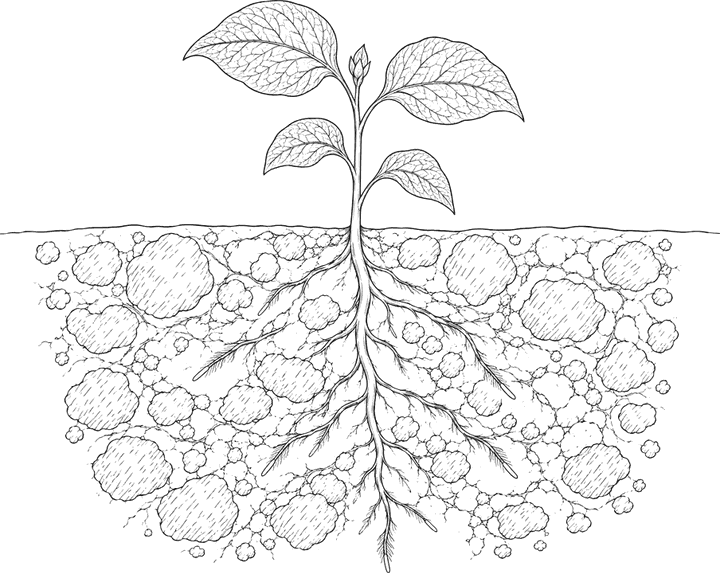
Scope, material and route
- Studied
- Cucumber (Cucumis sativus), cultivar Ashley
- Design
- Controlled experiment in hydroponic culture
- Material
- Sedimentary humic acid extracted from leonardite from the Danube basin (Czechia)
- Route
- Foliar spray, and root application to the nutrient solution in a separate experiment used for the hormone comparison
- Exposure
- Foliar 40 mg C per litre; root 100 mg C per litre. Study exposure, not application guidance.
- Duration
- Short term, with growth measured up to 72 hours after application
Study design
Root application
Added to the nutrient solution at 100 mg C per litre, in a separate experiment used for the hormone comparison.
5 plantsPer treatment and harvest time, for dry matter and hormones.
- GrowthImproved
- Root H⁺-ATPase activityRaised
- Root abscisic acidRaised
- Root auxin and shoot cytokininsRaised
- Root jasmonic acidRaised
Foliar spray
Sprayed on the leaves at 40 mg C per litre, the effective rate among those tested from 20 to 100.
5 plantsPer treatment and harvest time, for dry matter and hormones.
- Shoot and root dry matterIncreased at 72 hours
- Root H⁺-ATPase activityNot raised in the short term
- Abscisic acidLowered in roots and shoots
- Root auxin and shoot cytokininsRaised
- Root jasmonic acidRaised
More study details
- Research question
- Do root and foliar applications of the same humic acid act through the same short-term physiological responses?
- Outcomes measured
- Shoot and root dry matter, root architecture, root plasma membrane H⁺-ATPase activity, plant hormone concentrations, leaf trichomes and chloroplast starch
Findings
This study asked whether a humic acid applied to the roots and the same material sprayed on the leaves act on a cucumber plant in the same way. The researchers grew cucumber in nutrient solution and applied a sedimentary humic acid, extracted from leonardite, to the root solution or as a foliar spray. Both routes improved shoot and root growth. The short-term responses differed: root application raised root plasma membrane H⁺-ATPase activity and root abscisic acid, while foliar application did not. Both routes raised root jasmonic acid. Similar growth outcomes therefore did not reflect identical mechanisms. The findings concern this preparation, this species and these hydroponic conditions, not field soils.
| Outcome | Comparison or result | Interpretation |
|---|---|---|
| Shoot and root dry matter | Increased with foliar application at 72 hours; root application also improved growth | Both routes promoted growth under these conditions |
| Root architecture | Foliar application produced longer principal roots and fewer secondary roots | The route changed root form |
| Root H⁺-ATPase activity and root abscisic acid | Raised by root application; not raised in the short term by foliar application, which lowered abscisic acid in roots and shoots | The two routes engaged different responses |
| Root auxin (IAA) and shoot cytokinins | Raised by both routes | A shared hormonal response |
| Root jasmonic acid and jasmonoyl-isoleucine | Raised by both routes | The authors suggest a mild, transient stress response and say its role needs further work |
Interpretation and limits
What this record supports
That application route can change the physiological pathway behind a similar growth response, for this sedimentary humic acid in hydroponic cucumber.
What remains uncertain
- Field relevance. The work was done in nutrient solution over hours to days, not in soil through to harvest.
- Transfer. Other preparations, species and doses were not tested.
- Mechanism. The role of jasmonic acid is a hypothesis the authors say needs further investigation.
Which part of the framework it informs
Environmental conditions
The physical, chemical and management context.
Microbial activity
What microbial communities do within that context.
Observable function
What can be observed or measured in the host or wider system.
This record informs this area.
Source, funding and review
- Source type
- Peer-reviewed publication
- Associated products
- This record does not assess an associated product.
- Funding and relationships
- Supported by a Cátedra Timac Agro grant; the authors acknowledge the Roullier Group and the Government of Navarra. One author is affiliated with the Centre Mondial de l'Innovation Roullier, part of a fertiliser group. The authors declare no commercial or financial conflict of interest.
- Review status
- Prepared as an editorial summary. External scientific review has not been completed.
- What was read
- Full text read on the publisher's page.
- Original title
- Discriminating the Short-Term Action of Root and Foliar Application of Humic Acids on Plant Growth: Emerging Role of Jasmonic Acid
- Authors
- De Hita D, Fuentes M, Fernández V, Zamarreño AM, Olaetxea M, García-Mina JM
- Publication
- Frontiers in Plant Science 11:493, 28 April 2020
- DOI
- 10.3389/fpls.2020.00493
- Summary prepared by
- Carbon Biome Project
- Date added
- 19 October 2026
- Cite this summary
- Carbon Biome Project. Root and foliar applications of a humic acid produced different physiological responses. Evidence library record, added 19 October 2026. carbonbiomeproject.com/evidence/de-hita-2020-root-and-foliar-humic-acid-cucumber/
Related records
A humic product raised maize yield only on eroded upland soil in drier seasons.
Olk et al., 2021
Across 81 studies, humic substances raised early plant growth on average, with wide variation.
Rose et al., 2014
A straw-derived fulvic acid raised greenhouse tomato yield at one soil rate, not at lower or higher rates.
Zhang et al., 2021