
Peer-reviewed publication · Livestock · In the living system
A fulvic preparation was studied in older laying hens.
Older hens fed this fulvic acid for eight weeks laid eggs 0.29 g heavier, with slightly stronger shells and fewer breakages, while laying rate and feed use per egg did not change.
Xiao et al., 2 September 2022. Frontiers in Veterinary Science 9:953564.
Scope, material and route
- Studied
- Dawu Golden Phoenix laying hens from 55 weeks of age
- Design
- Randomised controlled feeding trial
- Material
- Fulvic acid from Beijing Sloan Biotechnology Co., Ltd; further characterisation not reported in the paper
- Route
- Feed
- Exposure
- 500 mg/kg of diet. Study exposure, not application guidance.
- Duration
- Eight weeks
Study design
Basal diet
The comparison.
126 hensSix replicates of 21 hens.
Plus fulvic acid
500 mg per kg of diet, eight weeks.
126 hensSix replicates of 21 hens.
What changed
- Egg weight61.08 against 60.79 g, 0.29 g heavier
- Shell breaking strength3.92 against 3.81 kg/cm²
- Egg breakage0.42 against 0.65 percent
- Serum AST19.80 against 28.27 U/L
- Caecal compositionSome groups shifted in relative abundance
What did not
- Laying rate83.37 against 81.92 percent
- Feed-to-egg ratio1.94 against 2.03
- Caecal diversityNo difference
- Total antioxidant capacityOpposite directions in the table and the text
More study details
- Research question
- How does dietary fulvic acid affect laying performance, blood biochemistry and caecal microbiota in older hens?
- Experimental unit and sample size
- 252 hens in two groups of six replicates with 21 hens each; blood from one bird per replicate; caecal microbiota from six birds per group
- Comparator
- Basal diet without fulvic acid
- Outcomes measured
- Laying rate, egg weight, feed-to-egg ratio, egg quality, serum biochemistry and antioxidant markers, caecal microbiota by 16S rRNA sequencing
Findings
Researchers assigned 252 Dawu Golden Phoenix hens aged 55 weeks to a basal diet or the same diet with 500 mg/kg fulvic acid, for eight weeks. Hens receiving fulvic acid laid slightly heavier eggs (61.08 against 60.79 g) with stronger shells, and fewer eggs broke (0.42 against 0.65 percent). Laying rate and the feed-to-egg ratio did not differ. Some blood markers changed, including lower AST. In the caecum, the relative abundance of some bacterial groups shifted, but microbial diversity did not differ. Observing production and microbial changes together does not establish that one caused the other, or that microbes consumed the preparation.
| Outcome | Comparison or result | Interpretation |
|---|---|---|
| Laying rate | 83.37 against 81.92 percent (P = 0.59) | No statistically supported difference |
| Egg weight | 61.08 against 60.79 g (P = 0.03) | A small increase |
| Shell breaking strength | 3.92 against 3.81 kg/cm² (P = 0.03) | A small increase |
| Egg breakage | 0.42 against 0.65 percent (P < 0.01) | Fewer broken eggs |
| Feed-to-egg ratio | 1.94 against 2.03 (P = 0.27) | No statistically supported difference |
| Serum AST | 19.80 against 28.27 U/L (P = 0.04) | Lower with fulvic acid |
| Antioxidant markers | GSH-Px higher (P = 0.02); total antioxidant capacity reported in opposite directions in the table and the text | The total antioxidant capacity result cannot be read with confidence |
| Caecal microbial diversity | No difference in alpha diversity; no clear separation in beta diversity | Overall diversity unchanged |
| Caecal composition | Firmicutes and Megamonas higher; Proteobacteria and Enterobacter lower (P < 0.01) | Shifts in relative abundance, not measured function |
Values are fulvic acid group first, control second, as reported in the paper. Values are extracted from the source as reported; no raw data were available.
Interpretation and limits
What this record supports
Small improvements in egg weight, shell strength and breakage for this preparation, dose and flock over eight weeks.
What remains uncertain
- Size. The egg weight difference was 0.29 g, small in absolute terms.
- Cause. Microbial and production changes were observed together; the study does not show that one caused the other.
- Reporting. The table and text disagree on the direction of total antioxidant capacity.
- Transfer. One breed, one age, one dose and one preparation.
Which part of the framework it informs
Environmental conditions
The physical, chemical and management context.
Microbial activity
What microbial communities do within that context.
This record informs this area.Observable function
What can be observed or measured in the host or wider system.
This record informs this area.
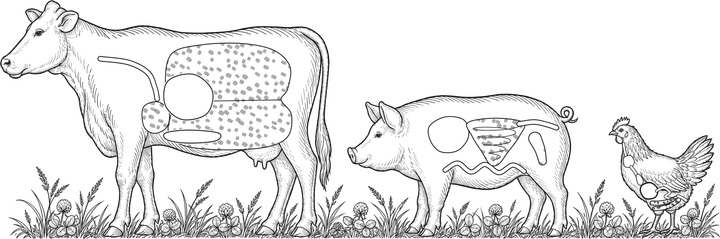
- a Caecal wall
- b Fine digesta
- c Bacteria
- d Mucus layer
Source, funding and review
- Source type
- Peer-reviewed publication
- Associated products
- The study tested a fulvic acid from a commercial supplier. This record does not assess an associated product.
- Funding and relationships
- Guangdong Province Modern Agriculture Poultry Industry technology system innovation team construction project and the Discipline Construction Program of Foshan University. The authors declare no commercial or financial conflict of interest.
- Review status
- Prepared as an editorial summary. External scientific review has not been completed.
- What was read
- Full text read on the publisher's page.
- Original title
- Effects of fulvic acid addition on laying performance, biochemical indices, and gut microbiota of aged hens
- Authors
- Xiao G, Liu S, Yan X, Yang Y, Qi Q, Feng X, Gong L, Zhang H
- Publication
- Frontiers in Veterinary Science 9:953564, 2 September 2022
- DOI
- 10.3389/fvets.2022.953564
- Summary prepared by
- Carbon Biome Project
- Date added
- 19 October 2026
- Cite this summary
- Carbon Biome Project. A fulvic preparation was studied in older laying hens. Evidence library record, added 19 October 2026. carbonbiomeproject.com/evidence/xiao-2022-fulvic-acid-aged-laying-hens/
Related records
In a university dairy crossover, somatic cell linear score was lower and daily milk showed only a tendency to rise.
University of Guelph, Ridgetown Campus, 2023
A follow-up dairy trial found no change in feed efficiency or milk, with shifts in milk fatty acids.
University of Guelph, Ridgetown Campus, 2024
Broilers fed humic substances carried fewer antimicrobial‑resistant E. coli isolates.
Pipová et al., 2025